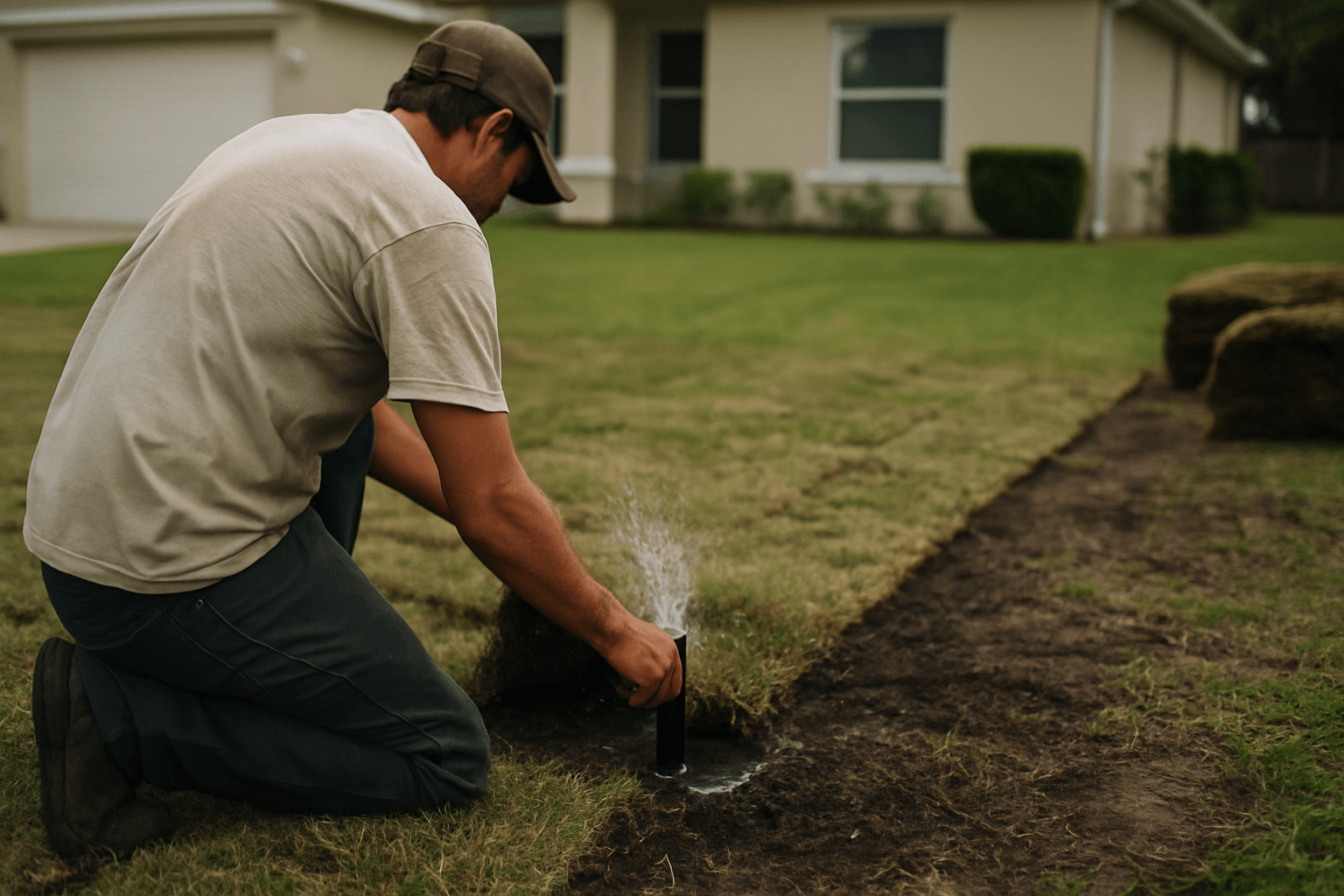
5 Signs Your Sprinkler System Needs Repair in Brevard County
A cracked sprinkler head can waste more than 25,000 gallons of water over a single dry season, and most homeowners never notice until the water bill arrives. In Brevard County, where the St. Johns River Water Management District already limits how often you can legally water, a failing system does not just cost money, it can put you out of compliance without you knowing it.
Here are five signs your sprinkler system needs repair, what usually causes each one, and when it makes sense to stop troubleshooting and call a professional. After 25 years repairing irrigation systems across Cocoa, Melbourne, Titusville, and the barrier islands, our team at Prolawn Turf and Landscape has seen just about every way these systems fail in Florida’s climate.
Key Takeaways
- Brown patches, soggy zones, and a sudden jump in the water bill are the three most common early warning signs of a failing system.
- Florida’s sandy soils and year round heat wear out sprinkler heads, valves, and lateral lines faster than cooler, clay soil climates do.
- St. Johns River Water Management District restrictions limit irrigation to specific days and times, so a malfunctioning system can put you out of compliance without you realizing it.
- Most single zone failures and broken heads can be repaired without replacing the whole system, but ignoring them long enough eventually forces a full replacement.
- A licensed irrigation contractor can usually diagnose a residential system in under an hour, often for less than the cost of one month of wasted water.
Why a Failing Sprinkler System Is a Bigger Deal in Brevard County
Brevard County sits in a subtropical climate with roughly 54 inches of rain a year, but most of that rain falls in the summer wet season between June and September. From October through April, many lawns get almost no meaningful rainfall, so irrigation carries the full load. That is exactly when a failing system does the most damage.
The county’s sandy, fast draining soil does not hold moisture well. A zone delivering even 20 percent less water than it should will show stress within two to three weeks during dry season. On the other end, a zone with a stuck open valve can saturate that same sandy soil to the point of drowning grass roots. There is very little margin for error compared to a loamy soil in a cooler climate.
The St. Johns River Water Management District covers Brevard County as part of its service area and maintains standing watering restrictions for both residential and commercial properties, on top of anything a city or county adds locally. A broken system makes it hard to stay inside those limits even when you are trying to follow the rules.
Sign 1: Dry or Brown Patches in a Repeating Pattern
Brown patches that show up in a repeating geometric shape, a rectangle, a strip, a circle, are almost always an irrigation problem rather than a disease or pest issue. Random spots scattered across the yard point to something biological. Dead zones that line up with your irrigation zones point to a system failure.
The most common cause is a clogged nozzle or a head that has drifted out of alignment. A single clogged rotor on a 4,000 square foot zone can leave a 15 foot wide dry patch even when every other head on that zone is working. St. Augustine grass, which covers most Brevard lawns, shows heat stress within days of missing a full watering cycle.
Before calling anyone, run each zone manually from the controller and watch every head. Look for heads that will not pop up, nozzles spraying the wrong direction, or heads blocked by overgrown plants. A single bad head is usually a quick fix. If more than one zone shows dry patches, or nothing looks obviously wrong at the heads, the problem is more likely in a valve, a lateral line, or the controller programming itself.
Sign 2: A Water Bill That Jumps for No Reason
A sudden 20 to 40 percent increase in a Brevard County Utilities or City of Titusville water bill, with no real change in household water use, is one of the clearest signs your sprinkler system needs repair. Most people assume a leak would be visible. The leaks that cost the most are usually the ones you cannot see.
A broken lateral line underground is the most expensive silent leak. In Brevard’s sandy soil, a break in a 1 inch lateral can wash out enough material around the pipe to eventually undermine a walkway or driveway edge. We have repaired lateral breaks under landscaped beds where the only visible sign above ground was a soggy patch about the size of a dinner plate, while the rest of that zone stayed bone dry.
A valve stuck in the open position is the other common culprit. When a solenoid valve sticks, that zone keeps running even when the controller has not called for it. The simplest check is to turn the controller off completely and walk the yard 30 minutes later. If any zone is still running or the ground is still wet, that valve needs sprinkler system repair attention.
Sign 3: Weak, Uneven, or Misting Spray Patterns
A head that used to throw a strong, even spray and now only mists, dribbles, or sprays in a broken pattern is telling you something about water pressure, not just the head itself. A single weak head can mean a clogged or worn nozzle. Every head on a zone spraying weak at the same time almost always points to a bigger issue, a partially closed valve, a leak somewhere upstream in that zone, or a pressure problem at the backflow preventer.
Misting instead of a clean spray pattern is often a sign of excess pressure rather than too little, especially right after a repair where a fitting was not seated correctly. Either way, misted water evaporates before it reaches the root zone, so the lawn can look underwatered even though the system runs on schedule every time.
This is one of the harder signs to catch without watching the system run, since most homeowners are not outside during a 4 a.m. cycle. Running a manual test during daylight, even just once a month, catches this early before it shows up as brown grass.
Sign 4: Zones That Stay Soggy Long After Watering
A soggy, spongy spot that never fully dries out, even a day or two after the last watering cycle, usually means a stuck valve, a broken lateral line, or a head that is not sealing shut. In Brevard’s sandy soil this often shows up as a slightly sunken area, since saturated sand compacts differently than dry sand around it.
Standing water for more than a few hours after a normal cycle is also a code compliance issue, since the St. Johns River Water Management District’s watering rules assume a system that shuts off and stays off between scheduled cycles. A zone that will not stop running is both wasting water covered by those restrictions and creating the kind of constantly wet conditions that invite fungus and root rot in St. Augustine and Zoysia lawns.
Sign 5: Sprinklers Running at the Wrong Time or Not at All
A zone that runs in the middle of the afternoon, skips its scheduled cycle entirely, or comes on twice in one day usually points to the controller rather than anything in the ground. Controllers lose their programming after a power flicker more often than people expect, and Florida’s summer storm season is hard on the wiring between the controller and the valves. A wire nicked during a landscaping project or chewed by a rodent can knock out one zone while every other zone keeps working normally, which makes the problem confusing to diagnose without testing each zone individually.
This is also the sign most likely to put a system out of compliance with local watering day restrictions without the homeowner realizing it, since a controller running on the wrong day or at the wrong hour is easy to miss unless someone happens to be home and watching. In some cases the fix is a simple sprinkler head or component replacement rather than anything more involved.
What to Do Once You Notice Signs Your Sprinkler System Needs Repair
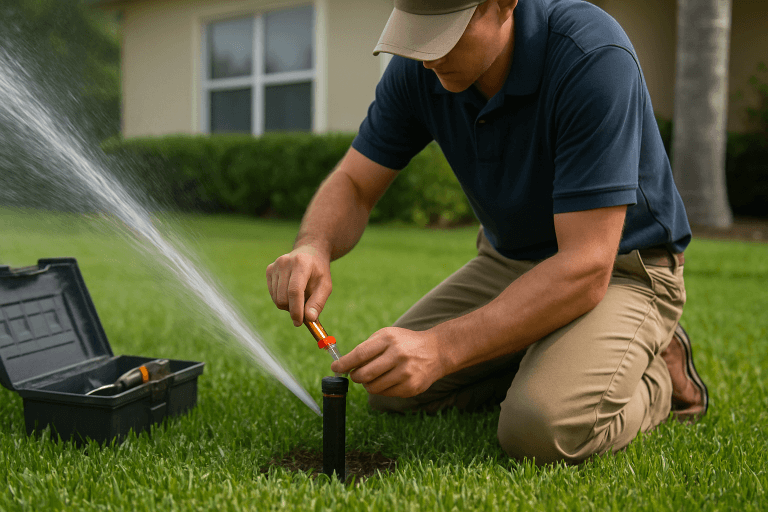
Most of what is described above can be diagnosed in a single visit. A technician runs every zone, checks pressure at the backflow preventer, and inspects valves and wiring at the controller before recommending anything. Single head repairs and valve replacements are usually finished the same day. A full lateral line repair or a controller replacement may take a bit longer depending on how much digging is involved.
If you are already seeing one or more of these signs your sprinkler system needs repair, the earlier you get a technician out, the less likely you are dealing with a full zone replacement instead of a single part. Prolawn Turf and Landscape handles both irrigation system repair and full sprinkler installation across Cocoa, Melbourne, Titusville, and the surrounding barrier islands, and most residential diagnostic visits are finished within the hour. You can request a quote online to get a visit scheduled.
Frequently Asked Questions
How much does it cost to repair a sprinkler system in Brevard County?
Most single head or single valve repairs run in a modest range and are finished the same visit. A broken lateral line or a controller replacement costs more depending on how much digging or rewiring is involved. A diagnostic visit upfront tells you which category the repair falls into before any work starts.
Can I fix a sprinkler system myself?
Replacing a single visible head is a reasonable DIY repair for most homeowners. Diagnosing a hidden lateral line break, a stuck valve, or wiring issues at the controller usually requires pressure testing and zone by zone troubleshooting that is faster and more accurate with a professional.
How often should a sprinkler system be inspected?
An annual inspection before the start of dry season, generally late summer or early fall in Brevard County, catches most problems before they show up as brown grass or a spiked water bill. Systems that are more than 10 years old benefit from a closer look, since valve diaphragms and wiring insulation both degrade over time.
Will a failing sprinkler system affect my water restrictions compliance?
Yes. A stuck valve or a controller running on the wrong schedule can put a property out of compliance with St. Johns River Water Management District watering restrictions even if the homeowner is trying to follow the rules. Fixing the system is also a compliance fix, not just a lawn fix.